
When searching for industrial property, you'll often see warehouses marketed as having either dock levellers, on-grade access, or a combination of both.
While these features both facilitate loading and unloading, they serve different operational requirements and can have a significant impact on efficiency, vehicle access and warehouse functionality.
Understanding the difference can help businesses identify the type of industrial property best suited to their operations.
What Is a Dock Leveller?
A dock leveller is a mechanical or hydraulic platform installed at an elevated loading dock.
It bridges the gap between the warehouse floor and the bed of a truck, creating a smooth transition for forklifts and pallet jacks moving goods in and out of vehicles.
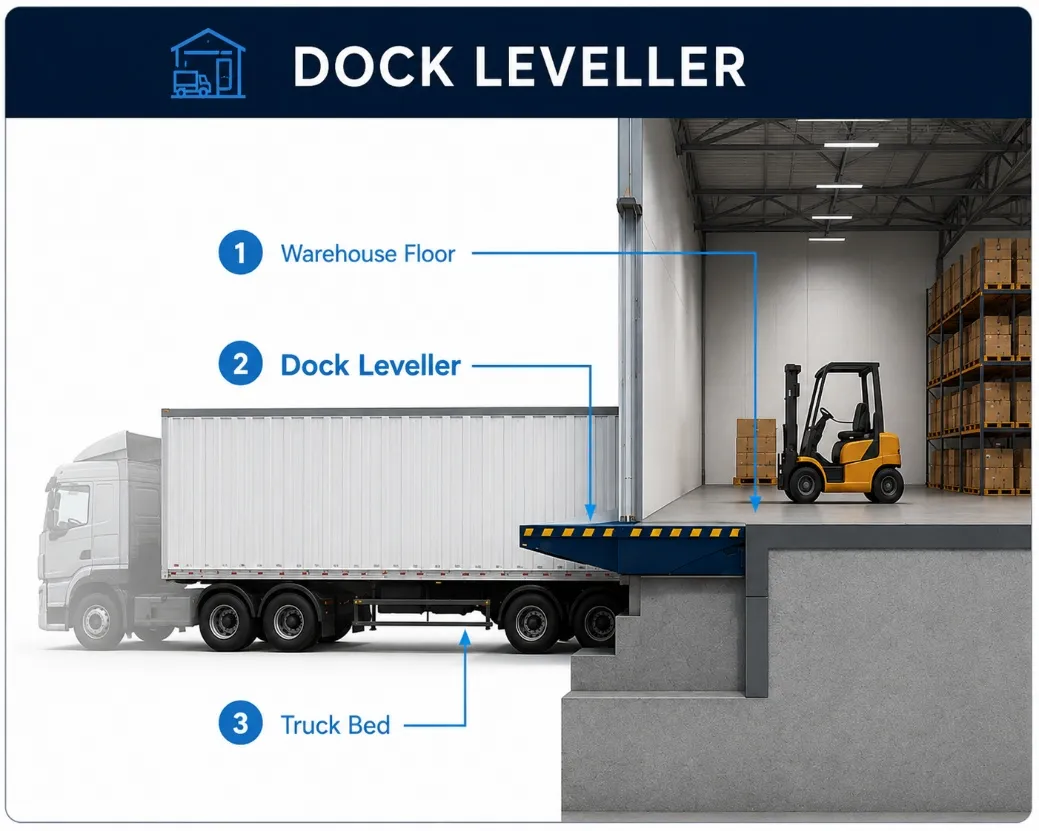
A dock leveller bridges the elevated warehouse floor and the truck bed.
How Dock Levellers Work
The warehouse floor is raised above ground level, and trucks reverse directly against the loading dock. The dock leveller adjusts to accommodate different vehicle heights, allowing goods to be loaded or unloaded safely and efficiently.
Advantages of Dock Levellers
- • Faster loading and unloading of palletised goods
- • Improved forklift efficiency
- • Reduced manual handling
- • Suitable for high-volume distribution operations
- • Can accommodate trucks with varying bed heights
Dock levellers are commonly found in:
- • Distribution centres
- • Logistics facilities
- • FMCG warehouses
- • Third-party logistics (3PL) operations
- • E-commerce fulfilment centres
What Is On-Grade Access?
On-grade access refers to a warehouse floor that is positioned at ground level.
Vehicles enter the warehouse directly through a roller shutter door without the need for an elevated loading platform.
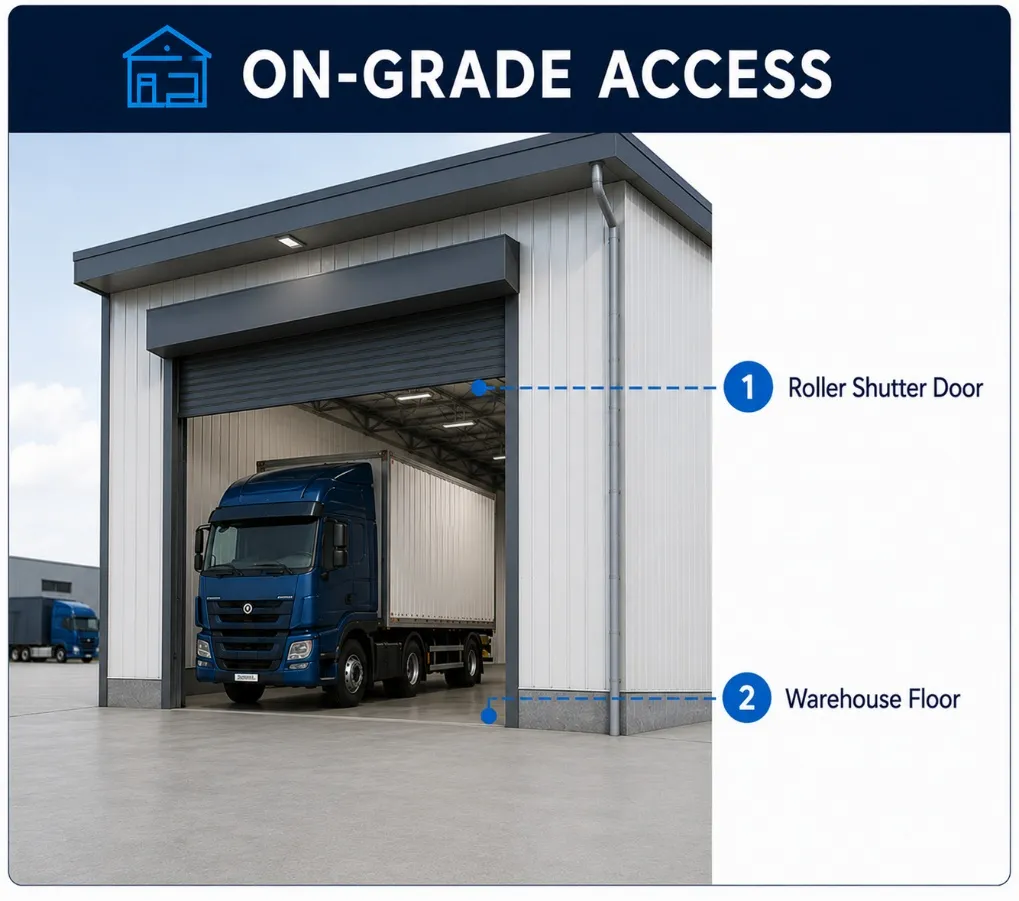
On-grade access lets vehicles drive straight into the warehouse at ground level.
How On-Grade Access Works
Trucks, delivery vehicles or forklifts can drive directly into the warehouse from ground level, making it particularly useful for operations requiring vehicle access inside the building.
Advantages of On-Grade Access
- • Easy vehicle access into the warehouse
- • Suitable for smaller delivery vehicles
- • Flexible loading arrangements
- • Often more cost-effective
- • Ideal for businesses handling machinery or oversized equipment
On-grade access is commonly found in:
- • Manufacturing facilities
- • Engineering workshops
- • Trade warehouses
- • Service centres
- • Light industrial units
Dock Leveller vs On-Grade Access: Key Differences
| Feature | Dock Leveller | On-Grade Access |
|---|---|---|
| Warehouse Floor Height | Elevated | Ground level |
| Truck Loading Efficiency | Excellent | Moderate |
| Forklift Loading | Highly efficient | Suitable |
| Vehicle Access Into Warehouse | Limited | Excellent |
| Distribution Operations | Ideal | Suitable |
| Manufacturing Operations | Suitable | Often preferred |
| Large Articulated Trucks | Ideal | Depends on site |
Which Option Is Better?
There is no universally better option.
The right choice depends on the nature of the operation.
Dock Levellers May Be Better Suited To:
- • Distribution centres
- • Logistics operators
- • Courier companies
- • High-volume warehousing
- • Businesses handling large quantities of palletised goods
On-Grade Access May Be Better Suited To:
- • Manufacturing businesses
- • Engineering operations
- • Trade suppliers
- • Equipment storage
- • Businesses requiring vehicles to enter the warehouse
Why Some Warehouses Offer Both
Many modern industrial facilities incorporate both dock levellers and on-grade access doors.
This provides greater flexibility by accommodating both high-volume truck loading and direct vehicle access.
For businesses with diverse operational requirements, a warehouse offering both features can provide the best of both worlds.
Final Thoughts
Dock levellers and on-grade access are designed to solve different operational challenges.
Dock levellers typically improve loading efficiency for high-volume logistics operations, while on-grade access offers flexibility for businesses that require direct vehicle access into the warehouse.
When evaluating industrial property, it is important to consider not only the size and location of the facility, but also how goods, vehicles and staff will move through the space on a daily basis.
Understanding these features can help occupiers identify a warehouse that aligns with their operational requirements both now and in the future.
Key Takeaways
- • A dock leveller bridges an elevated warehouse floor and a truck bed; on-grade access puts the floor at ground level behind a roller shutter door.
- • Dock levellers suit high-volume palletised throughput — distribution, logistics, FMCG, 3PL and e-commerce fulfilment.
- • On-grade access suits operations that need vehicles inside the building — manufacturing, engineering, trade and light industrial.
- • Neither is universally better; the right configuration follows the operation, not the other way around.
- • Many modern facilities offer both, giving occupiers flexibility as their requirements change.
- • Assess how goods, vehicles and staff will move through the space daily — not just size and location.
Looking for Industrial Property in Cape Town?
Whether your business requires dock levellers, on-grade access, large yard areas or specialised warehousing infrastructure, Baker Street Properties can help you identify facilities that match your operational requirements.
Contact our industrial property team to discuss your space requirements and available opportunities across Cape Town's key industrial nodes.
Get in Touch