
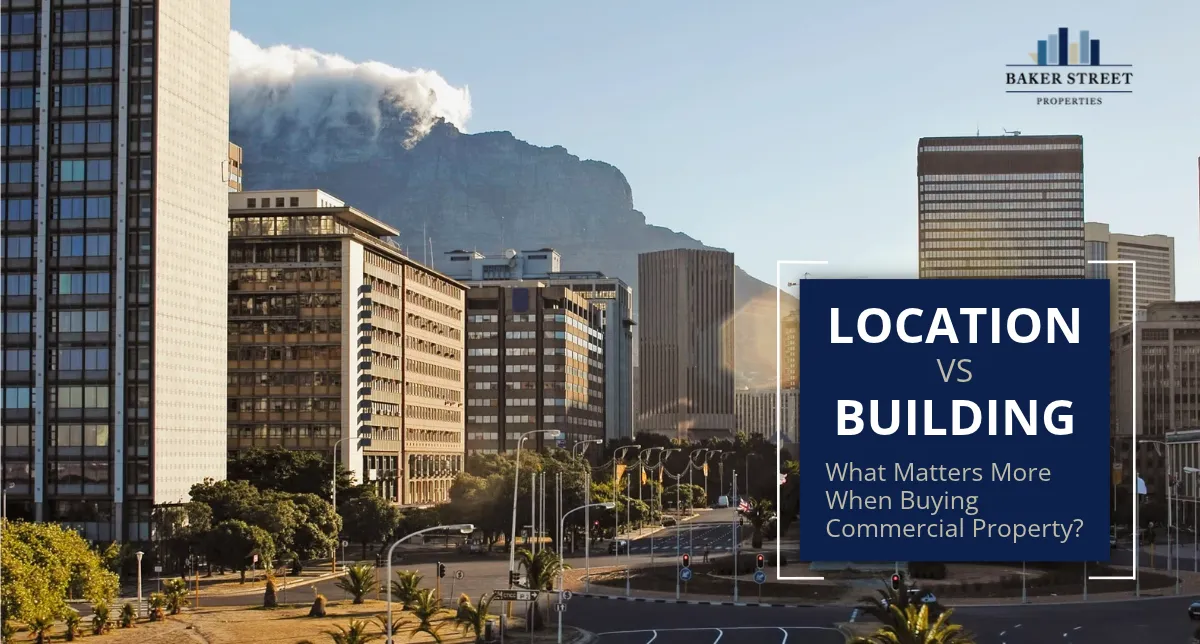
In Cape Town commercial property, location usually does more for long-term value than building design. A modern building with good finishes, plenty of parking and the latest tech can look very good, but a building can be refurbished. You cannot move its access, its node or the land under it.
The latest SAPOA figures point the same way: decentralised Cape Town office vacancy was 2.7% in Q3 2026, against 11.0% for decentralised nodes nationally. Building quality still matters, and we cover where it matters most below.
Why can you change a building but not its location?
Buildings get renovated all the time. Offices are upgraded, layouts are reworked, parking can sometimes be added, and even an old industrial building can be refurbished until tenants want it again. The location stays exactly where it is.
That’s why experienced investors look hard at the surrounding area before they look at anything else. A good building in a poor location can be a struggle to let, while a plainer building in a strong location tends to retain its tenants.
How does location drive demand for office, retail and industrial property?
Commercial property comes down to demand, and businesses want premises that work for their staff, their customers and their operations. An office has to be easy to get to. A retail property needs visibility and passing traffic. An industrial property needs good access for staff, deliveries and distribution.
Being close to major roads and public transport usually helps. In Cape Town, access to the N1, N2, N7 and R300 matters to a lot of businesses, and the same goes for the established commercial and industrial nodes.
Will tenants pay more for a better location?
Where a property is has a direct effect on what tenants will pay for it. A business will often put up with an older building if it’s in the right area, and it may even spend its own money improving the space because the location suits how it trades.
An industrial tenant, for example, might well choose an older building in an established industrial area with good road access over a newer one somewhere less proven. Building quality still counts, but a strong location can make up for some of its weaknesses.
How does location protect value when the market changes?
Economic conditions shift, interest rates go up and down, and tenant preferences change. Well-established commercial nodes tend to keep attracting businesses through all of that because of their access, infrastructure and the activity already there.
A building designed for today’s requirements may not suit the market in ten or fifteen years. A well-located property has more options when that happens: you can refurbish it, change the layout, convert it to another use or, sometimes, redevelop it. SAPOA suggests some of the fall in older office vacancies may reflect conversions to residential and other uses. That gives the land underneath a big role in long-term value.
So as an investor, look past the building. Are the roads and infrastructure improving? Are businesses moving in? Is the municipality investing in the precinct? Is there a shortage of suitable commercial space? The answers have a big effect on future values and rental demand.
What do the latest Cape Town figures show?
The Western Cape is growing, and the numbers make the case for location better than any argument can.
- • Population: Census 2022 counted 7.43 million people in the Western Cape, up 27.7% on 2011 and the fastest growth of any province (Stats SA).
- • Investment: Wesgro facilitated 16 investment projects worth R21.8 billion in 2025/26 (Western Cape DEDAT Annual Report).
- • Offices: The City of Cape Town is the tightest major metro in the country, with office vacancy of 6.9% in Q3 2026 against 11.8% nationally. Decentralised Cape Town offices sit at just 2.7% (SAPOA Office Vacancy Survey, Q3 2026).
- • Industrial: Cape Town industrial vacancy averaged about 3.3% in the first half of 2026, the tightest of the major metros, with very limited developable land (Rode Report, Q2 2026).
The node-level data shows how office performance varies across Cape Town’s nodes (all office grades):
| Cape Town office node | Vacancy, Q3 2026 |
|---|---|
| Rondebosch/Newlands | 0.7% |
| Waterfront | 0.8% |
| Century City | 2.0% |
| Bellville | 3.1% |
| Central (incl. Pinelands) | 3.1% |
| Claremont | 5.3% |
| CBD Cape Town | 14.0% |
Source: SAPOA Office Vacancy Survey, Q3 2026. All grades.
The CBD is Cape Town’s largest office node, and approximately 60% of its stock is B- and C-grade, which is where most of its vacant space sits. This reflects the shift of increased demand to quality office.
Which Cape Town industrial nodes benefit most from their location?
Demand for well-located industrial and logistics property is strong, and the established nodes keep winning because of their road, port and airport links.
| Node | Key routes | What it suits |
|---|---|---|
| Paarden Eiland | N1, R27, close to the port and CBD | Port-linked operations, trade counters, light industrial |
| Montague Gardens | N1, N7 | Warehousing, distribution, light industrial |
| Epping | Between the N1 and N2 | Central manufacturing and distribution |
| Airport Industria | N2, R300 | Air freight and time-sensitive logistics |
| Bellville South | R300 to the N1 and N2 | Northern suburbs distribution |
When does building quality matter more than location?
None of this means building quality doesn’t matter. Within a strong node, the building often decides who lets first. In Bellville, A-grade offices were 0.8% vacant in Q3 2026, while C-grade space in the same node was 20.4% vacant. Nationally, Prime offices sit at 4.7% vacancy against 15.9% for B-grade (SAPOA, Q3 2026).
Location sets the ceiling, and the building decides how close you get to it. A well-designed, well-maintained building can attract better tenants, lower operating costs, make the tenant’s experience better and cut future capital expenditure.
The best investment is a good building in a good location. But if you have to choose between an excellent building in a mediocre location and an average building in an excellent one, the second will often turn out to be the better long-term buy, because the average building can be upgraded and the location cannot.
Commercial property investor checklist: what to ask before you buy
Location
- •Is the property in an established commercial or industrial area?
- •Is it easy for customers, staff and suppliers to reach?
- •Is it close to major roads and public transport?
- •Is the surrounding area growing or improving?
- •Are there other successful businesses nearby?
Tenant demand
- •Is there strong demand for this type of property?
- •Would it be easy to let if the current tenant leaves?
- •What type of businesses are likely to want the space?
- •Is it suitable for more than one type of tenant?
The building
- •Is it structurally sound?
- •Does it have adequate parking?
- •Is the layout practical?
- •Will it need major upgrades or maintenance?
- •Can it be adapted if tenant requirements change?
Financials
- •Is the rental income market-related? Is it quoted gross or net? (gross vs net explainer)
- •What are the operating costs?
- •Are there maintenance or capital expenses coming up?
- •Does the expected return justify the purchase price?
- •What could the property be worth in five or ten years?
Future potential
- •Are there infrastructure improvements planned nearby?
- •Is the area attracting new businesses and investment?
- •Could the property be redeveloped or upgraded later?
- •Does the zoning allow the property to be used as intended?
- •What could happen to demand if the local market changes?
The final question
Before you make an offer, ask yourself one thing: am I buying an attractive building, or a strong location with long-term potential?
The best commercial property investments usually start with the location and only then consider the building. A great building can lose its appeal over time, but a strong location can keep creating value for many years.
Frequently asked questions
Is location more important than the building in commercial property?
Usually, over the long term. A building can be refurbished, re-planned or redeveloped, but its access, surrounding businesses and infrastructure are fixed. Building grade still affects how quickly space lets and at what rental.
What is the office vacancy rate in Cape Town?
Cape Town office vacancy was 6.9% in Q3 2026, the lowest of South Africa’s major metros. Decentralised nodes were 2.7%, while the CBD, which has a large share of B- and C-grade stock, was 14.0% (SAPOA, Q3 2026).
Why is location so important for industrial property in Cape Town?
Industrial occupiers depend on truck access, staff access and proximity to the port, the airport and the N1, N2, N7 and R300. Developable land in established nodes is limited, which keeps vacancy low.
Key Takeaways
- • A building can be refurbished, re-planned or redeveloped; its access, node and the land under it cannot be moved.
- • Cape Town is the tightest major metro: 6.9% office vacancy against 11.8% nationally, and just 2.7% in its decentralised nodes (SAPOA, Q3 2026).
- • Cape Town industrial vacancy averaged about 3.3% in the first half of 2026, with very limited developable land.
- • Established industrial nodes such as Paarden Eiland, Montague Gardens, Epping, Airport Industria and Bellville South keep winning on road, port and airport links.
- • Within a strong node, the building decides who lets first: in Bellville, A-grade offices were 0.8% vacant against 20.4% for C-grade.
- • Location sets the ceiling, and the building decides how close you get to it.
Thinking of buying or letting in Cape Town?
Baker Street’s brokers work these nodes every day. Speak to our brokers about a specific property or browse our current commercial property for sale and industrial properties to let.
Speak to Our Brokers